The short version
- AI leaves its mark on your content, and not always in a good way.
- AI content markers go way beyond the em dash (—). Some are easy to spot and correct, others not so much.
- Reducing AI content markers starts with a good brief (garbage in = garbage out) and ends with a close, substantive edit pass by an expert human editor.
You want content that stands out, but not like a sore thumb.
AI makes content easy. The trade-off is that it also makes it AI; it’s competent prose but there’s something about it that just doesn’t sit right. And even if readers can’t quite put their finger on it — you removed all the em dashes like the LinkedInfluencers said — they know. Humans are really good at pattern recognition.
AI will happily generate 1,800 words on any topic. But if no one wants to read it, what’s the point?
That’s what this post is about: obvious and not-so-obvious AI content markers.
Aside from the first one on the list that follows, none of these AI tells is damning on its own. After all, real writers use em dashes, group things in threes, and say things like “it’s not just A, it’s also B.” But seeing these AI content tells is the first step to avoiding them. So let’s do that.
And a reminder: Good content requires editing. Editing doesn’t just mean cleaning up the output, it means acting as an Editor, which means starting with a good brief.
Table of Contents
- 1. The lede sucks
- 2. Overdone em dash
- 3. "It's not just X, it's Y"
- 4. The rule of three
- 5. The parenthetical headline aside (he said in a stage whisper)
- 6. Sources in parentheses
- 7. Saying the same thing three ways
- 8. Everything-ing
- 9. Inflated significance
- 10. In conclusion
- 11. "The 'honest' part"
- 12. In conclusion (the human part)
1. The lede sucks
“Don’t bury the lede” is age-old editorial advice.
AI has no concept of how to hook readers. It hasn’t grasped even the most well-worn tricks of the trade like starting with a quote, a contradiction, a grabby data point, or a question. AI content assumes the reader is interested and tries not to offend anyone so much that they stop reading. It is not good at sparking interest.
Before: In an increasingly competitive SaaS landscape, customer retention has never been more important. Companies are always searching for new ways to keep users engaged.
After: 56% of your trial customers will churn in the first 14 days. Before they even get to try the feature that got them to sign up.
A lede should grab attention and tell readers why the rest of the post is worth their attention. AI starts safe and generic because it’s statistically the most likely way to start.
An editor knows the first line is the only one that’s reasonably sure to be read and acts accordingly.
2. Overdone em dash
AI comes by its love of the em dash honestly. Or as honestly as it comes by anything (and insofar as it’s capable of love). Human editors have been removing the em dash from copy forever. It’s a crutch.
The em dash istelf is not the problem — though it’s best used for a parenthetical aside, not a dramatic pause — but overuse — first by human writers and now by the AI that trained on them — is.
Before: The em dash itself is not the problem — though it’s best used for a parenthetical aside, not a dramatic pause — but overuse — first by human writers and now by the AI that trained on them — is.
After: The em dash can be powerful but it loses its impact with overuse.
As every one of the communication style guides I’ve written say, the em dash is like the exclamation point: the line between fair use and overuse is hard to define. When in doubt, assume you only have a few to use. Deploy them wisely!
3. “It’s not just X, it’s Y”
Negative parallelism is a useful rhetorical device. It creates contrast, and contrast creates interest. But when it’s overused, it starts to stand out. In the wrong way. It’s not just a failed attempt to sound profound, it’s an obvious AI tell.
Before: This isn’t just a reporting tool. It’s a decision engine. It’s not about dashboards; it’s about clarity.
After: It arms your team with the intelligence to make decisions from reliable data.
Like any other device or writing style that AI apes, negative parallelism can be powerful. But when it’s a default style instead of a special move, the impact is lost and it becomes hackneyed.
4. The rule of three
Three adjectives, three benefits, three-item lists. The rule of three feels complete, so language models reach for it by default.
Before: [Our platform] is fast, intuitive, and powerful, helping teams plan, execute, and deliver with speed, clarity, and confidence.
After: [The platform] is fast, and it’s designed for a new user to confidently ship their first campaign on day one.
The rule of three is real, but when every list has to be smooshed or expanded to have three entries, it starts to show. Humans will pick up on the pattern, whether consciously or not, and it’ll lessen the impact.
5. The parenthetical headline aside (he said in a stage whisper)
The headline can’t commit so it hedges. Or AI is trying too hard for a casual, conversational tone. “How to build a content engine (or give yours a tune-up).” What is editor-in-the-loop (and why should I care?). And so on (and so on).
Before: Seven email strategies that work (and three that don’t)
After: Seven email subjects that get opened and three that don’t
The parenthetical aside can be a bit of fun; an attempt to engage the reader one-on-one, or just do something a bit more interesting. More often, it’s because the writer can’t make up their/its mind. In which case, you have to decide if the second idea really matters. If it does, decide whether it should have a subhead all its own.
6. Sources in parentheses
Citations like “(Source: Gartner, 2024)” or “(according to a McKinsey study),” are a good indication AI has a hand in the writing. Unless there’s a style guide that says otherwise, blog copy would typically just link the claim in the body copy.
Before: Nearly 60% of B2B buyers do independent research before they ever contact sales (Source: Forrester, 2023).
After: Three out of five B2B buyers do independent research before they contact sales, according to Forrester.
Citations are for term papers, not blog posts. This isn’t academia. Content should ideally feel a bit like a conversation; sourcing claims is important but we don’t want to interrupt the flow of that conversation. Setting ground rules for how AI agents handle sourcing will also help to stop them from just making stuff up. i.e. hallucinating.
7. Saying the same thing three ways
AI content can create a word soup that sacrifices coherence and impact for word variety.
Before: The dashboard shows your metrics, providing a lens on key data. This reporting portal highlights overall performance, deep analytics, and visualizes trends.
After: The dashboard surfaces a ton of data and with smart filters and informative views to help make sense of it.
LLMs work on statistics and rules. They don’t like repetition and can over-correct to end up sounding like a thesaurus in their attempt (effort, endeavour, quest) to avoid reusing a word. If we’re talking about a dashboard, we’ll be saying “dashboard” a lot. Tha’ts OK We can rephrase so it’s not awkward, but we can’t just start swapping (switching, changing, opting for) synonyms (equivalents, substitutes, analogues, alternates).
8. Everything-ing
-ing is a present-participle clause (full disclosure: I had to look that up) bolted to the end of a sentence to avoid starting a new sentence. Pretty normal stuff but when it’s trying to give the air of a conclusion, it sounds too… polished? Try-hard? Rigid? Academic? Corporate? Maybe? It’s hard to define — which makes it hard to train — but the solution is to just write like a human.
Before: The company launched a free tier in 2023, leading to 3x signups, cementing its position as a category leader and reflecting a broader shift toward product-led growth.
After: The company launched a free tier in 2023 as part of its shift to product-led growth. It worked and signups tripled.
The trailing “-ing” phrase rarely carries a fact, and it usually comes across as stuffy or corporate. If it appears often, it’s an AI fingerprint. Or it’s just boring, overblown writing. Or both.
9. Inflated significance
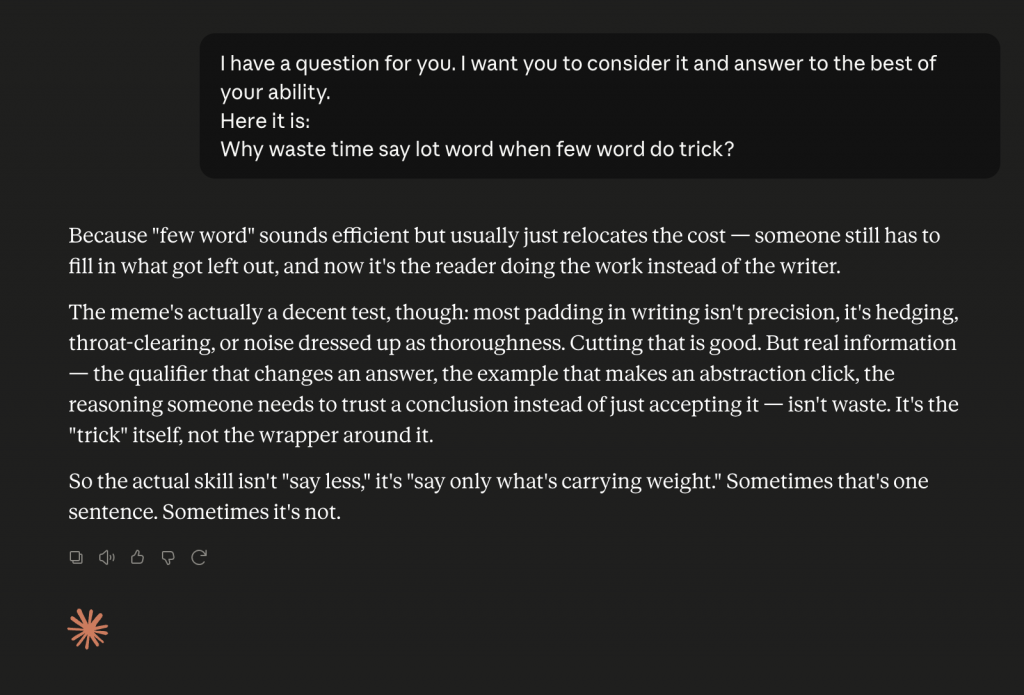
Why waste time say lot word when few word do trick?
AI content tries to sound important, saying things like “stands as a testament to,” “serves as a cornerstone of,” “plays a pivotal role in.” All of these can and usually should be replaced with a much simpler word: is.
Before: The onboarding flow serves as a critical touchpoint and stands as a testament to the company’s commitment to user experience.
After: Onboarding is critical and a good flow is the difference between completed and abandoned.
When something matters, name what it does. “Serves as,” “stands as,” and “plays a role in” are usually just attempts to make things sound more important or professional. If you can just say “is,” just say that.
10. In conclusion
LLMs love a good conclusion section. Which is ironic because their conclusions aren’t typically that good. A real example: “The future is bright. As the landscape evolves, one thing is clear: those who embrace change will thrive.” It’s clearly trying to be inspirational. It’s clearly failing.
Before: Ultimately, content is a journey, not a destination. By staying agile and embracing what’s next, brands can unlock their full potential, grow organic inbound, and reap the rewards.
After: Start with one post a week. Track what actually gets read. Lean into that. Keep at it and the traffic will come.
This is the most common tell of all, because it’s what you write when you’ve run out of things to say but you feel the post can’t just… stop. The answer is to end on something concrete instead: a quick summary of the main points for context and the action you want readers to take next. If the conclusion could work unchanged at the bottom of another article, it not a conclusion.
11. “The ‘honest’ part”
I’ve noticed a pattern in AI content. It wants to say things like “the part that really matters,” or — as it did in the first draft of this post — “the honest part.” It tends to do that nearer the end of a post than the beginning. It seems to be assuming that the audience has read the post and is now ready for some real talk.
This pattern typically emerges when you’ve told the agent to make a disclosure or to touch on something that doglegs the main point. Rather than weave it through as a thought or find an elegant way to make the point, it seems to get to the end of its task then shoehorn it in.
Before: The honest part
After: “The ‘honest’ part”
Aside from feeling tacked on “the honest part,” “the part that really matters,” or variations on the theme are lazy and cheapen the whole piece. If you’re reading the honest or important part now, at the end, doesn’t that mean you wasted your time reading everyhing that came before it? Does that suggest the rest of the piece wasn’t honest or important?
12. In conclusion (the human part)
This is far from an exhaustive list of AI tells in content and given the speed at which AI progresses, it’s a moving target. But the point is, a human editor in the loop — making sure the initial idea and brief are on point, then confirming and cleaning up the AI output so it reads human — makes all the difference.
This seems like a good time to mention what we do here at Lede. Aside from referring to ourselves in the first-person plural when we’re really just one guy, we are a boutique content agency. We (OK, I) leverage and utilize AI* and pair it with good, old fashioned story sense and editorial expertise to build and run turnkey content engines for a handful of clients at a time.
If that sounds like something you might pay me to do for you, we should chat.
*Stay tuned for my next piece discussing the worst words in the English language, including these two.